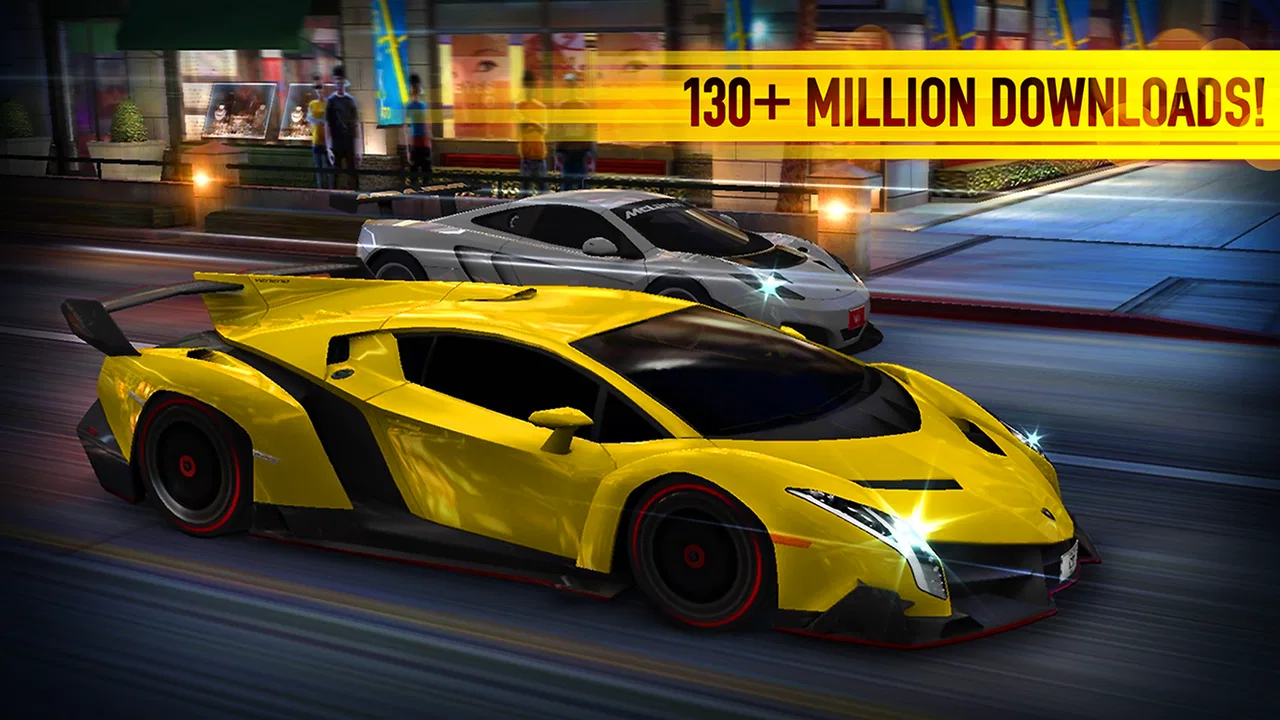
CSR Racing
- 3.6
- Rating
- 50.00M
- Installs
- Free
- Price

 Analysis by App-foxy
I approached CSR Racing as a quick-play racing game rather than a traditional circuit racer. That distinction matters from the first launch: the appeal is built around drag racing, where timing, acceleration, and choosing the right upgrade matter more than steering through a long course. If you enjoy short competitive runs and the satisfaction of improving a car step by step, Zynga’s game has a clear reason to stay installed. If you want open roads, detailed cornering, or a full simulation, you should know what kind of racing experience you are choosing before downloading it.
The game is free to download and is rated Everyone, which makes it approachable for a wide audience. It has been available since April 3, 2013, and its long life is reflected in its broad reach: it has passed 50 million installs, with an average rating of 3.6 from around 2.4 million ratings and roughly 170 thousand written reviews. Those figures suggest a game that has attracted a very large audience while also producing a mixed response, so I would not treat its popularity alone as proof that it will suit every player.
What to consider before choosing this racing game
My first decision criterion is the kind of control you want. In a conventional racing game, I expect to steer, brake, judge corners, and recover from mistakes through physical driving. Here, the focus is much narrower and more deliberate. A race is about making the right input at the right moment, then understanding whether the car’s performance is strong enough for the opponent in front of you. That makes each event easy to begin, but it also means players looking for hands-on driving may find the experience limited.
You May Also Like

 Blood Strike: 2.5 Anniversary
Blood Strike’s Loadouts Turn Every Drop Into a Tactical Gamble
A close look at Blood Strike’s custom loadouts: how fast access to signature weapons reshapes its battle royale rhythm, rewards preparation, and narrows the gap between fights.

 Pandora - Music & Podcasts
Pandora’s Music Is Easy to Start, but Harder to Recover
Pandora’s strength is its low-effort path from a seed to a station. Its weak spot is how much confidence it asks you to place in connection, setup, and quiet recovery.

 8 Ball Pool
 Is Built on Rivalries, Rematches, and Routine
A close look at the rivalries, rematches, shared routines, and unanswered safety questions that turn a quick pool match into a persistent mobile community.

 Samsung Music
’s Quiet Strength Is Playing What You Already Own
Its reach comes less from spectacle than from dependable access to a personal library. That simplicity is both the app’s strongest retention engine and its ceiling.

 AccuWeather: Weather Radar
AccuWeather Review: A Quick, Clear Forecast for Everyday Decisions
For everyday plans, the best forecast is the one you can understand quickly. AccuWeather makes rain timing, radar, and local conditions easy to act on, with a few trade-offs.

 Hill Climb Racing
Why Hill Climb Racing Still Turns Crashes Into One More Run
A tiny car, a bumpy hill and one more upgrade: Hill Climb Racing keeps resurfacing because its simple chaos makes every near-miss feel personal.
More From Our News Desk



The second criterion is session length. I found the drag-racing format well suited to small gaps in the day. A quick race can feel more manageable than committing to a longer championship or a full circuit event. I could play a few rounds while waiting for an appointment, then stop without feeling that I had abandoned a complicated race halfway through. This is one of the game’s practical strengths: it turns racing into a series of compact decisions instead of a long uninterrupted activity.
The third question is whether you enjoy progression more than exploration. The satisfaction here comes from building a better-performing garage, learning the rhythm of launches and gear changes, and deciding where an improvement will make the greatest difference. The game is less suitable if your main motivation is discovering new tracks, experimenting with free movement, or creating your own racing line through corners.
I also paid attention to how the game feels when progress becomes more demanding. Early races can teach the basic rhythm without asking too much from the player. Later, small errors become more noticeable, and a car that seemed competitive can suddenly feel underpowered. That change is useful because it gives upgrades a purpose, but it can also create pressure to spend more time repeating events or considering purchases.
That is an important part of the decision. CSR Racing is free, but it includes in-app purchases ranging from $0.99 to $99.99 per item. I would begin with the free experience and treat spending as optional, not as part of the basic download. Anyone who dislikes progression systems that can encourage additional purchases should approach it carefully, especially if the urge to keep up with tougher opponents becomes frustrating.
How the drag-racing format changes the experience
Drag racing looks simple because the track does not demand constant steering, but the simplicity is deceptive. The challenge moves from navigation to timing. I had to pay attention to the start, make gear changes with consistency, and recognize when a race was being lost because of poor execution rather than a weak car. That creates a satisfying learning loop: instead of blaming every defeat on an opponent, I could identify one specific moment to improve.
A useful habit is to separate driving mistakes from garage problems. If I lose after a late shift or a poor launch, buying an upgrade would not solve the real issue. I would first replay the race and concentrate on cleaner inputs. If the run is tidy but the opponent still pulls away, then the car’s configuration becomes the more likely obstacle. This simple distinction helps prevent unnecessary spending and makes the progression feel more understandable.
The format also makes repetition more meaningful than it might be in a circuit racer. Repeating a short race is not only a way to earn progress; it is a practice session. I can test whether a more controlled launch works better, whether I am shifting too early, and whether a performance change actually improves the result. Players who enjoy refining a small technique will probably get more from the game than players who need constant visual variety.
There is a trade-off, though. Because the driving space is restricted, the game’s excitement depends heavily on the tension of the start and the changing gap between cars. If that rhythm does not appeal to you, the races may begin to feel repetitive. I would not recommend it as a substitute for a steering-focused racer simply because both games use cars. They ask for different kinds of attention.
Where CSR Racing is strongest
The clearest strength is accessibility. I did not need to learn a complicated control scheme before understanding the basic objective. The game presents racing as a sequence of readable moments, which makes it comfortable for someone who enjoys cars but does not want a demanding simulation. It is also easy to imagine using it on a phone in short bursts, since the individual races do not require the same commitment as a long endurance event.
Another strength is the connection between performance and decision-making. A win is not only about tapping quickly. I also have to think about which car deserves attention, when an improvement is worthwhile, and whether my current approach is failing because of timing or preparation. That gives the garage a practical role rather than making it a purely cosmetic collection.
I especially liked the way the game can turn a small improvement into a clear personal goal. If I am consistently losing near the finish, I can focus on one upgrade or one part of my timing instead of changing everything at once. That makes the experience easier to understand and gives a new player a sensible workflow: learn the race, identify the weakness, make one change, and test again.
The game’s age is also interesting. Having launched in 2013, it belongs to an earlier generation of mobile racing design, but its central idea remains easy to grasp. Players who prefer straightforward menus and a focused race format may appreciate that directness. On the other hand, anyone expecting the broader systems and presentation of newer mobile racers may notice that it feels more like a classic mobile progression game than a modern console-style driving experience.
Its Everyone content rating makes it a reasonable family-friendly choice in terms of the stated age classification, but I would still explain the purchase model to younger players. Free access and optional items can feel very different to a child who wants to keep advancing. Setting expectations before handing over the phone is more useful than assuming the rating answers every practical question.
Three ways to get more from each session
My first practical tip is to use short sessions for diagnosis rather than mindless grinding. Before starting, choose one goal: improve the launch, make cleaner shifts, or decide whether the current car needs attention. This keeps repeated races from becoming a blur and gives each attempt a purpose. It is a small change, but it makes the game feel more like a skill challenge and less like a waiting process.
Second, avoid changing several things at once. If I alter the car and change my timing in the same session, I cannot tell what caused the result. Testing one adjustment at a time makes the progression easier to read. This is particularly helpful for players who are tempted to spend immediately after a loss. A careful test can reveal that the problem was execution, not equipment.
Third, treat difficult races as a signal to review the whole routine. I would check whether I am entering the event with the right car, whether my shifts are consistent, and whether I am repeating a mistake at the same point. The non-obvious benefit of a drag racer is that its narrow format exposes patterns quickly. In a circuit game, a poor result can come from many corners; here, the cause is often easier to isolate.
A realistic everyday scenario shows where the game fits best. Suppose I have ten minutes before a train arrives. I can complete a few short races, notice that my launch is costing me the opening gap, and spend the next attempts practicing that moment. I do not need to remember a large track layout or reserve a long block of time. When the train arrives, I can stop with a clear sense of what I was working on. That compact loop is more convincing to me than the idea of using it for a long, relaxed evening of varied racing.
When another type of racing game is a better choice
I would choose a conventional arcade racer instead if steering is the main reason I play. Those games are better for weaving through traffic, taking corners, using the whole track, and feeling the car respond continuously to movement. CSR Racing cannot provide that same sense of physical driving because its challenge is concentrated in acceleration and timing.
I would also look elsewhere for a simulation-focused experience. Players who care about realistic handling, braking points, tire behavior, or detailed vehicle setup may find this game too streamlined. Its appeal is not in reproducing every part of driving; it is in making a small slice of racing easy to repeat and gradually improve.
For open-world exploration, a different category is clearly more appropriate. I would not install this expecting free roaming, sightseeing, or spontaneous routes. The game works best when I want a defined challenge with a clear beginning and end, not when I want a virtual place to explore.
There is also a social consideration. If you mainly want a shared racing experience with friends, check whether the specific multiplayer expectations you have match what you want from this title before committing your time. I would choose it for its focused solo-style progression and quick races, not simply because it belongs to the racing category. That distinction can prevent disappointment when comparing it with games designed around direct online competition.
In other words, the best alternative depends on the feeling you want. Choose this game for timing, compact races, and garage improvement. Choose a steering-heavy arcade game for movement and spectacle. Choose a simulation for technical driving. Choose an exploration racer for freedom. These are not minor variations; they are different reasons to play.
What switching costs in practice
Moving from another mobile racer to CSR Racing is not difficult in terms of controls, but it does require changing your expectations. A player accustomed to steering may initially tap too aggressively or look for a driving line that is not central to the experience. I would give myself a few races to learn the timing before deciding whether the format works for me.
The larger cost is time spent learning a new progression rhythm. If I have already invested effort in a garage elsewhere, starting again can feel less appealing. This game is most worth trying when I want a different kind of racing challenge, not when I am searching for a direct replacement with identical systems.
There is also a financial switching cost, even though the download is free. The purchase range means I would set a personal limit before playing, particularly if I tend to spend when a game blocks progress. My preferred approach is to use the free portion as a test: if the timing-based races are not enjoyable without pressure, paying will not fix that basic mismatch.
Device compatibility is straightforward for many users because the minimum requirement is Android 5.0, while the current version is 5.1.5. I would still keep the operating system and available storage in mind before installing, especially on an older phone. The important point is that the game is not presented as a premium purchase; the initial commitment is low, but the ongoing progression model deserves more attention than the download price alone.
My recommendation after weighing the trade-offs
I recommend CSR Racing to players who want a free, approachable drag-racing game that fits into short sessions. It is a good match if you enjoy improving timing, making focused garage decisions, and repeating a race until a small change produces a better result. The large install base shows that the concept has broad appeal, and I can understand why: the rules are easy to grasp, while the timing gives experienced players something to refine.
I would skip it if your ideal racing game requires steering, open tracks, realistic handling, or constant environmental variety. I would also be cautious if optional purchases tend to make you feel pressured. The game can be enjoyed without treating every defeat as a reason to buy something, but that discipline matters because the progression can make a stronger car feel like the obvious answer.
For me, the fairest way to judge it is to play several sessions with a clear limit and a specific improvement goal. Focus on timing first, then evaluate whether the garage decisions remain enjoyable. If the answer is yes, the game offers a neatly contained racing loop that works especially well during spare moments. If the answer is no, a steering-based racer will probably give you more variety and a stronger sense of control.
Overall, Zynga’s title is not a universal replacement for every racing game, and it does not try to be one. Its identity comes from narrowing racing down to launches, shifts, performance choices, and the tension of a short run. My recommendation is to try it for the focused drag-racing challenge, not for a full driving simulation. That expectation makes its strengths clearer, its limitations easier to accept, and the free download a sensible low-risk way to decide whether its rhythm suits you.
FAQs for CSR Racing
01What is CSR Racing, and what can I expect from the gameplay?
CSR Racing is a drag-racing game focused on short, highly competitive races rather than traditional steering. You choose the right moment to shift gears, use your nitrous boost, upgrade your car, and compete against rival crews. The races are easy to understand, but progressing through higher tiers requires careful timing, smart tuning, and regular improvements to your vehicle.
02Is CSR Racing free to download and play?
CSR Racing can generally be downloaded and played for free, but it includes optional in-app purchases. Players may buy virtual currency, upgrades, or other resources to progress more quickly. It is possible to enjoy the main racing experience without spending money, although progression can become slower and some upgrades may require patience, repeated races, or careful management of the resources earned during gameplay.
03Does CSR Racing require an internet connection?
An internet connection may be required for several important features, including downloading game data, synchronizing progress, accessing events, viewing advertisements, and using online-related content. Some basic racing activities may work when you are offline, but the complete experience is not guaranteed without connectivity. A stable connection is recommended, especially when participating in live events or restoring saved progress.
04What devices are compatible with CSR Racing?
CSR Racing is designed for supported Android and iOS smartphones and tablets, but compatibility depends on the operating system version, available storage, hardware performance, and the specific edition available in your region. Because the game includes detailed car graphics and animated environments, older devices may experience longer loading times, reduced visual quality, or occasional performance issues. Check the official store listing before downloading.
05Are there advertisements or in-app purchases in CSR Racing?
Yes, CSR Racing may include advertisements and optional in-app purchases. Advertisements can sometimes provide rewards or additional resources, while purchases may offer virtual currency, fuel, upgrades, or other advantages that speed up progression. Parents should review the device’s purchase settings if children use the game. Spending is not mandatory, but players who avoid purchases may need to manage fuel and upgrades carefully.
Pros
- Fast
- responsive controls make drag racing easy to pick up.
- Large selection of licensed cars adds variety for collectors.
- Short races fit well into quick gaming sessions.
- Visual customization lets you create a distinctive garage.
- Regular events provide extra challenges beyond the main campaign.
Cons
- Energy limits can interrupt play during longer sessions.
- Upgrades and repairs may become expensive as progress continues.
- Random reward systems can make rare parts difficult to obtain.
- Some races strongly favor players with upgraded vehicles.
- The game requires substantial storage and may use considerable battery.

CSR Racing
Gallery